Notes From IAA Mobility 2025: Advancing the Paradigm of Intelligent Mobility

The IAA Mobility 2025, held in Munich, Germany, from September 9 to 14, represented a pivotal moment in the global automotive landscape. Under the theme “It’s All About Mobility,” the event convened 750 exhibitors from 37 countries and featured more than 350 world premieres and innovations. This biennial gathering underscored the industry’s accelerating transition toward electrification, digitalization, and sustainability. Major European original equipment manufacturers (OEMs), including Volkswagen, Mercedes-Benz, and BMW, alongside prominent Chinese entrants such as Changan, Aion, Leapmotor, XPeng, and Dongfeng, presented their latest battery electric vehicles (BEVs), extended-range electric vehicles (EREVs), new energy vehicles (NEVs), and hybrid models. The exhibition was thoughtfully divided into two formats: the IAA Summit, a business-to-business (B2B) platform emphasizing industry networking and unveilings of concept vehicles and technologies; and the Open Space, a business-to-consumer (B2C) arena providing interactive public access to the newest vehicle launches.
Beyond the spectacle of vehicle reveals, IAA Mobility 2025 highlighted profound collaborations between OEMs and leading software and technology firms, signaling the maturation of Software-Defined Vehicles (SDVs). Advancements in integrated Advanced Driver Assistance Systems (ADAS), autonomous driving capabilities, next-generation powertrains, X-by-wire systems, digital user interfaces, alternative lightweight materials, enhanced safety protocols, and innovative high-voltage (HV) battery and charging solutions were recurrent themes. The concurrent IAA Summit & Conference facilitated substantive dialogues among industry experts, policymakers, technology leaders, and journalists, fostering critical discourse on the trajectory of mobility. As Europe’s automotive sector navigates geopolitical tensions, supply chain vulnerabilities, and regulatory imperatives toward net-zero emissions by 2050, this edition of IAA Mobility affirmed the sector’s resilience and innovative potential.
Conference Insights: Navigating the EV Transition and Strategic Imperatives
The conference program at IAA Mobility 2025 offered incisive analyses of the electric vehicle (EV) transition and broader industry shifts. Discussions framed the challenge through a three-layered action framework essential for a successful pivot. First, the transformation of automotive companies entails the introduction of approximately 350 new EV models, achieving 20–50% cost reductions, accelerating development cycles twofold, and developing 3–4 regionalized portfolios tailored to diverse markets. Second, establishing a future-oriented value chain involves bolstering seven key European technology fields, scaling battery production from 150 GWh to 700 GWh by 2030, and securing supplies of 14 critical raw materials. Third, ensuring a level playing field requires €350 billion in infrastructure and grid investments by 2035, alongside the deployment of 8,000 charging stations per week to support net-zero objectives.
The stakes are considerable: approximately one-third of the European Union’s gross domestic product (GDP) is at risk should the transition falter, exacerbated by an average EU vehicle fleet age of 13 years, which could delay renewal cycles. Key imperatives include expediting infrastructure deployment, fortifying supply chains, and harmonizing efforts with net-zero targets. In the realm of ADAS, BMW’s collaboration with Qualcomm on the Snapdragon Ride Pilot system—now validated across 60 to over 100 countries—exemplifies scalable advancements. This Level 2+ solution supports highway and urban driving, integrated into the Neue Klasse platform with compliance to Driver Control Assistance Systems (DCAS) standards, ensuring reliable driver safety responses.
MAHLE’s strategic presentation, “Efficiency in Motion,” articulated a multifaceted approach encompassing internal combustion engine (ICE) efficiency enhancements, EV electrification, advanced thermal management, and range extenders as transitional solutions. The Boston Consulting Group (BCG) provided a forward-looking assessment of robotaxis, projecting a $50 billion initial investment and over 400 million kilometers of testing data. Consumer adoption is anticipated to exceed 40% by 2030, with profitability emerging after approximately seven years, contingent on fleets of 15,000–20,000 vehicles executing 18 trips per day to achieve break-even.
Insights from HolonIQ and Lyft illuminated EV mobility and infrastructure dynamics: EV passenger cars are projected to account for only 4% of electricity demand, yet charging behaviors vary significantly—38% home charging in China, 68% in Germany, and 81% in Norway—with regional patterns, such as Singapore’s dense urban environments, necessitating customized strategies. Substantial capital investments are required to scale infrastructure effectively. Market data from IAA 2025 revealed robust growth in Germany, where BEV sales increased by 38% and hybrid sales by 59%, reflecting strong momentum in electrified propulsion. A notable trend is the rise of REEVs offering over 1,000 km range, spearheaded by innovators like Rimac, Horse, and Aisin. The event’s focus evolved from IAA 2023’s emphasis on sustainability and circularity to 2025’s priorities of artificial intelligence (AI), REEVs, and charging infrastructure.
Key takeaways from the conference include: the globalization of ADAS facilitated by progressive regulations and accelerated partnerships for testing and approvals; multiple decarbonization pathways, encompassing EVs, hybrids, hydrogen, and optimized ICE technologies; the necessity of ecosystem-wide investments through shared platforms and collaborations to mitigate costs; the imperative to tailor charging networks, policy frameworks, and capital strategies to regional contexts; a shift from rhetorical commitments to actionable implementations; and recognition of a tipping point where collective action among OEMs, suppliers, policymakers, and energy providers is paramount to sustaining Europe’s leadership in EVs.

Vehicle Launches: A Spectrum of Electrified Innovations
The new vehicle launches at IAA Mobility 2025 exemplified the industry’s commitment to accessible, high-performance electrification. Entry-level offerings prioritized affordability and urban utility. CUPRA’s Raval, priced from $27,000, emerged as a dynamic compact crossover blending sporty handling with electric efficiency. Renault introduced the Clio E-Tech Hybrid at $29,588, combining seamless petrol-electric synergy for everyday versatility, and the R5 E-Tech Electric at $32,400, a nostalgic yet forward-looking hatchback delivering 400 km of range on a 52 kWh battery.
Ford’s Puma Gen-E, starting at $35,200, refined the compact SUV segment with mild-hybrid technology for optimized fuel economy. Opel’s Mokka GSE, at $46,000, offered German-engineered precision in an electric package, enhanced by OpelConnect for integrated digital services. The Turkish marque Togg debuted the T10F at $49,300, a fastback EV with 314 horsepower, 523 km range, and Level 2 autonomy, underscoring emerging markets’ global ambitions.
In the mid-range, Smart’s #3 Keith Haring edition ($57,000) fused artistic heritage with A-segment EV agility. Togg’s T10X ($57,250) complemented its sibling as a more versatile SUV. Scout’s Terra Truck ($60,000), a Volkswagen Group venture, targeted North American preferences with a 400-mile range and robust off-road capabilities. Mercedes-Benz’s CLA ($61,000) epitomized refined electric luxury on the MMA platform, boasting 750 km range and a hyperscreen interface.
Premium entries included Smart’s #5 Summit Edition ($66,700), a boxy yet opulent SUV, and BMW’s iX3 50 xDrive ($80,000), featuring all-wheel drive, 500 km range, and a Curved Display. Mercedes-Benz’s GLC 400 4Matic ($80,000) hybridized its bestseller for 100 km of electric-only driving. Volvo’s ES 90 ($117,400) delivered serene electric propulsion with over 600 km range. Polestar’s 5 ($140,906) impressed as a 650-horsepower grand tourer with sustainable materials. At the apex, Porsche’s 911 Turbo S Hybrid ($272,650) integrated a T-Hybrid V6 yielding over 700 horsepower and a 0-100 km/h sprint in 2.6 seconds, preserving the model’s iconic performance heritage.
These launches reflected strategic diversification: entry-level models to broaden adoption, premium variants to sustain profitability, and hybrids as pragmatic bridges. Chinese OEMs, while not exhaustively detailed in primary overviews, contributed significantly, with their booths showcasing competitive pricing and rapid innovation cycles.
Concept Vehicles: Visions of Future Mobility
Concept vehicles at IAA Mobility 2025 served as conceptual blueprints for tomorrow’s transportation paradigms. Volkswagen’s ID. Every1 reimagined the multi-purpose vehicle as a modular EV van, accommodating families or commercial fleets with swappable batteries and adaptable interiors. BMW’s iX5 Hydrogen advocated for alternative fuels, achieving 500 km range with refueling times comparable to conventional vehicles. Skoda’s Epiq and Vision O previewed compact, connected urban EVs, embodying accessible Czech engineering.
Volkswagen’s ID. Cross introduced rugged versatility in an EV format. Mercedes-AMG’s GT XX pushed hypercar boundaries with over 1,000 horsepower in an electric configuration optimized for track dominance. Audi’s Concept C suggested a spacious electric sedan evolving from e-tron GT lineage. Cupra’s Tindaya infused rally-inspired dynamics into electric architecture.
Renault’s Emblème evoked elegant French design in a grand tourer form. Hyundai’s Insteroid and Kia’s EV2 Concept prioritized compact, stylish urban mobility. Porsche’s 911 Spirit 70 honored heritage through hybrid innovation, while Renault’s 5 Turbo 3E electrified a legendary hot hatch. Hyundai’s Concept Three reconfigured the multi-purpose vehicle for spacious efficiency, Caterham’s Project V delivered lightweight EV roadster purity, Opel’s Corsa Vision GS targeted sporty urbanites, and Pix Moving’s Pix Beastie proposed autonomous micro-pods for last-mile solutions.
These concepts transcended mere aesthetics, previewing production-viable technologies and signaling a fluid mobility ecosystem encompassing personal, shared, and autonomous applications.
Technological Innovations: The Backbone of Transformation
Technological exhibits at IAA Mobility 2025 illuminated the enablers of this evolution. In ADAS and SDV domains, Bosch advanced brake-by-wire and steer-by-wire systems, eliminating mechanical linkages for software-configurable hardware and centralized zonal architectures. Vehicle Motion Management (VMM) integrated longitudinal, lateral, and vertical dynamics holistically. Hyundai Mobis’ Vision LINK platform consolidated autonomous driving, telematics, and vehicle-to-everything (V2X) communications into a unified SDV framework.
Aumovio’s AI-enhanced cameras addressed low-light and glare challenges, with the Xelve platform scaling from Level 2 to Level 4 automation. Microvision’s Tri-LiDAR architecture provided comprehensive 360-degree sensing across ranges, leveraging micro-electro-mechanical systems (MEMS) for precise beam steering and low-speed autonomy. Fraunhofer IDMT integrated acoustic sensing via exterior microphones and AI for real-time detection of sirens, horns, or collisions. Auve Tech’s MiCa 2.0, a Level 4 autonomous mini-bus, incorporated automatic emergency braking, 360-degree awareness, and redundant systems powered by Auve Stack 2.0 AI.
Wireless charging solutions eliminated physical connections: Porsche’s 11 kW One-Box integrated power electronics into the vehicle floor, guided by cameras and air suspension. MAHLE and Siemens’ inductive system employed magnetic positioning for precise alignment. Valeo’s bidirectional vehicle-to-grid (V2G) capability positioned EVs as grid stabilizers. Easelink achieved 99% efficiency via automated pad connections, and Vmaxpower’s WEVC incorporated foreign object detection and living object protection.
HV battery innovations enhanced endurance and safety. CATL’s Shenxing Pro delivered 758 km WLTP range, 478 km in 10 minutes of charging (viable at -20°C), and 10,000 cycles with 70% capacity retention. Xing Mobility’s immersion-cooled cell-to-pack system in Caterham’s Project V offered 55 kWh capacity, 200 kW output, and 20–80% state-of-charge in 15 minutes. Factorial’s FEST solid-state platform reached 375 Wh/kg density, sub-15-minute fast charging, and 90% reduced thermal runaway risk. Ducati’s (Volkswagen Group) V2L electric race bike utilized QuantumScape solid-state cells for 844 Wh/L density and 12-minute charging.
Electric drive systems prioritized efficiency and compactness. Hyperdrives’ Ultra achieved 12 kW/kg density with waveguide cooling and 98% efficiency. Protean’s Pm18 hub motor delivered 2,500 Nm torque and 96% peak efficiency. BorgWarner’s HVH series motors attained 97% efficiency and 1,829 Nm torque. Valeo’s 6-in-1 eAxle integrated multiple components for 250 kW output and reduced rare-earth usage.
Chassis technologies embraced X-by-wire paradigms. Hyundai Mobis’ integrated electronic brake and rear-wheel steering systems enhanced manoeuvrability. Aumovio’s full-dry brake and compact corner modules minimized weight. Inovance’s parallel-axis steering and Schaeffler’s planetary roller systems supported ASIL D safety for autonomous applications.
Thermal management addressed efficiency in extremes. MAHLE’s integrated heat pump extended range by 20%, while Valeo’s Predict4Range software recovered up to 24% via immersion cooling. Materials science progressed with Kirchhoff’s 25% lighter aluminum cross-car beams and Magna’s OPTiForm enclosures optimizing capacity and recyclability.
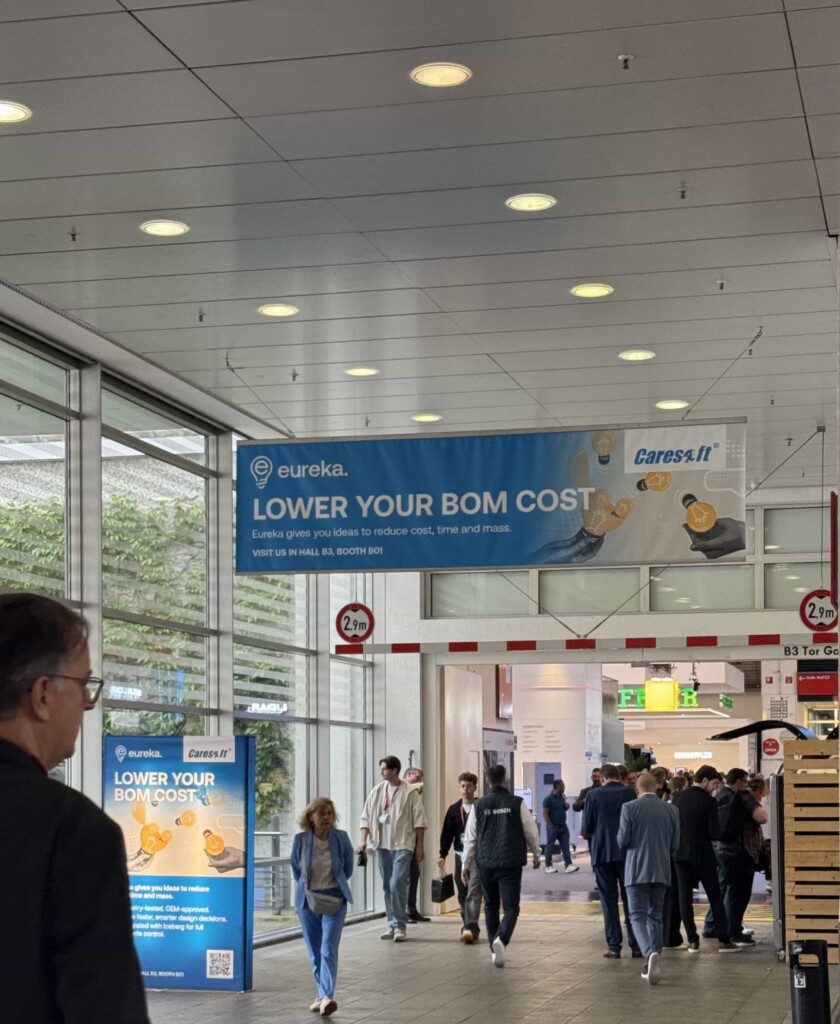
Caresoft Global and the Xiaomi YU7 Showcase
Amid the OEM-dominated halls, independent exhibitors like Caresoft Global provided nuanced perspectives on engineering and cost optimization. Positioned in Hall B3, Booth B01, Caresoft Global—a global leader in automotive benchmarking and cost reduction engineering—highlighted its Eureka platform for cost reduction and innovation during a presentation by Senior Director Azgar Ullashariff at the IAA Yellow Forum. A centrepiece of their booth was the Xiaomi YU7, one of China’s fastest-selling electric SUVs, priced at approximately $35,000, underscoring the brand’s aggressive expansion into European markets.
The Xiaomi YU7, unveiled as a high-performance luxury SUV rivalling the Tesla Model Y, featured dimensions of 4,999 mm in length, 1,996 mm in width, and 1,600 mm in height, offering spacious interiors for five passengers. Its rear-wheel-drive standard variant delivered 235 kW (315 horsepower) and 528 Nm of torque from a 96.3 kWh battery, achieving a CLTC range of 835 km and a top speed of 240 km/h. The all-wheel-drive Pro and Max trims escalated to 496 and 681 horsepower, respectively, with the top model accelerating from 0–100 km/h in 3.2 seconds and supporting an 800V architecture for ultra-fast charging. Powered by a Snapdragon 8 Gen 3 cockpit, the YU7 incorporated advanced ADAS, multi-duct aerodynamics with 10 air channels for optimized airflow, and premium safety features, positioning it as a benchmark for intelligent luxury.
At the Caresoft booth, the YU7 not only drew crowds for its aesthetic appeal, echoing the SU7 sedan’s design language, but also facilitated discussions on teardown analyses and supply chain efficiencies, aligning with Caresoft’s expertise in benchmarking. This showcase exemplified how collaborative platforms bridge Eastern innovation with Western engineering standards, potentially accelerating EV adoption through cost-effective scalability.
Forging a Collaborative Path Forward
IAA Mobility 2025 crystallized the automotive industry’s resolve to surmount electrification’s complexities through innovation and partnership. From conference imperatives on infrastructure and supply security to launches spanning $27,000 urban EVs to $272,650 hybrid supercars, and from ADAS breakthroughs to the Xiaomi YU7’s compelling presence at Caresoft Global’s booth, the event projected a multifaceted future. As Europe safeguards its EV preeminence amid global competition, the emphasis on ecosystems—uniting OEMs, suppliers, regulators, and innovators—will determine success. This edition transcended exhibition; it catalyzed progress toward sustainable, intelligent mobility for all.
Disclaimer:
The content provided on this blog is for informational purposes only and should not be construed as professional advice. While we strive to ensure the accuracy of the information presented, Caresoft Global makes no warranties, either express or implied, about the completeness, reliability, or accuracy of the content on this blog. Some information may be outdated, obsolete, or inaccurate, and we strongly recommend that you independently verify any information before relying on it. Any action you take based on the information provided on this blog is strictly at your own risk. Caresoft Global will not be liable for any losses or damages in connection with the use of our blog. Links to third-party websites are provided for convenience and informational purposes only; they do not constitute an endorsement or approval by Caresoft Global of any products, services, or opinions of the corporation, organization, or individual.
Related Insights


News
Highlights from the IAA presented by Azgar Ulla Shariff, Senior Director at Caresoft Global
Are you rich in data but poor in action? Many in the...


Thinking
The Future of Automotive Thermal Management: A Deep Dive into Innovations and Challenges
Prideep Subramaniam, VP, APAC Sales Imagine an...
